


When Dr. Brennan Asplen began work last summer as the new superintendent of St. Johns County Schools, he had an immediate crisis to solve; the district was already facing a budget shortfall of $3.5 million. He scrambled to answer that through cuts to the district office and applying some other strategies, taking actions that would avoid impacting classrooms.
But the district’s funding woes were about to get worse.
Just after winter break this year, the state Department of Education notified Asplen that, because the district has about 1,000 students fewer than its projection for this year, it would have to pay back $8 million by June 30.
That’s because state funding is predicated on these projections. Property taxes collected locally are distributed to the various districts according to a formula. Currently, St. Johns County receives about $9,147 per full-time student.
Ironically, it was the state that made the erroneous projection and funded it accordingly. In fact, Asplen said, the state overestimated school districts across Florida, collectively, by about 50,000 students.
So, every month, the district has been forced to return funding incrementally.
But that $8 million impact is expected to balloon to as much as $23 million by the end of the next school year if action is not taken. And this is not a matter of the district simply failing to live within its means; rather, it can be traced to some arguably well-intentioned legislation that has precipitated what might be described as unintended consequences.
Asplen, joined by District 4 School Board Representative Kelly Barrera, addressed the issue Monday, April 13, during a public meeting hosted by the Palm Valley Community Association.
St. Johns County Schools is looking at a potential budget shortfall of $15 million due to two causes: unfunded mandates and vouchers.
The first occurs when the state imposes a regulation that costs the district money but does not allocate funding to back it up. An example might be the student-teacher ratio, which may necessitate hiring of more teachers and construction of more schools.
The second has shown itself to be the more problematic of the two.
In March 2023, Gov. Ron DeSantis signed legislation allowing education funds to “follow the student.” The statute was celebrated by many as it helped students to move to schools or districts that offered a higher quality of education.
But this is not restricted to movement between public schools. Some parents might prefer to enroll their children in private schools for religious or other reasons. Others may opt for homeschooling. The funding would move with them.
And the same rate would apply: $9,147 per student. It would simply be paid to the private school or, in the case of homeschooling, to the parents.
As a result, these funds are being siphoned off the budgets for public schools. And while some might argue that this is a wash, the reality is that school districts face regulatory and funding challenges that private schools and homeschool families do not, at least not to the same degree.
Maintenance of numerous facilities, providing transportation and meals and other responsibilities are disproportionately borne by the districts.
Complicating the situation, that $9,147 might be viewed as income — particularly in the case of homeschooling. And the district has no way to compete with that.
Asplen suggested that the state simply refund property taxes paid by parents educating their children outside the public school system. This would presumably return a portion of that $9,147 to the district.
If the school district is unable to re-acquire the $8 million it is currently returning the state, the projected $15 million shortfall would then expand to $23 million.
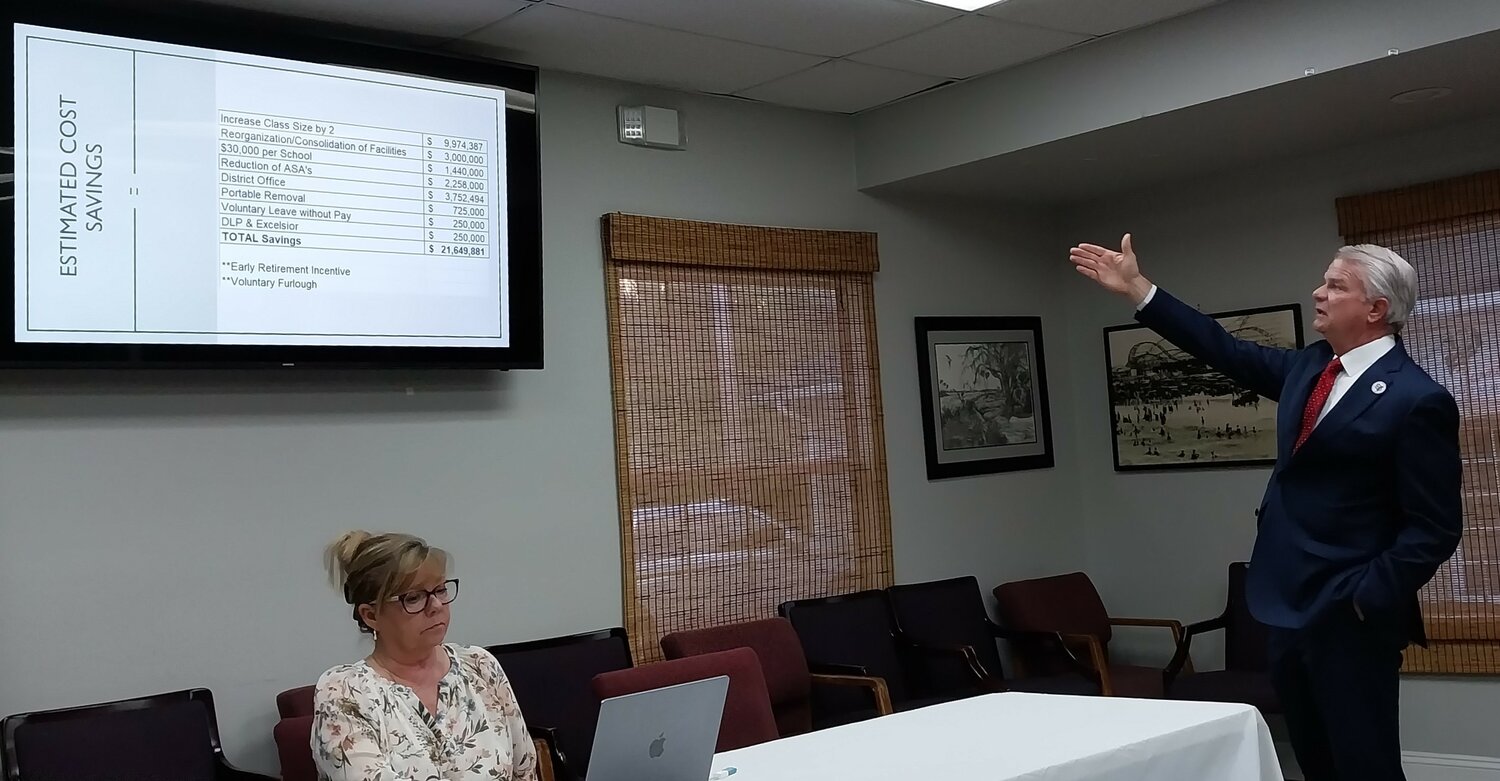
At Monday’s meeting, Asplen enumerated strategies he hopes to take to meet this deficit. These include reorganization or consolidation of facilities, ending leases for space at properties not owned by the district, removal of several portables, increasing class sizes by two students (allowed under certain circumstances) and more.


