
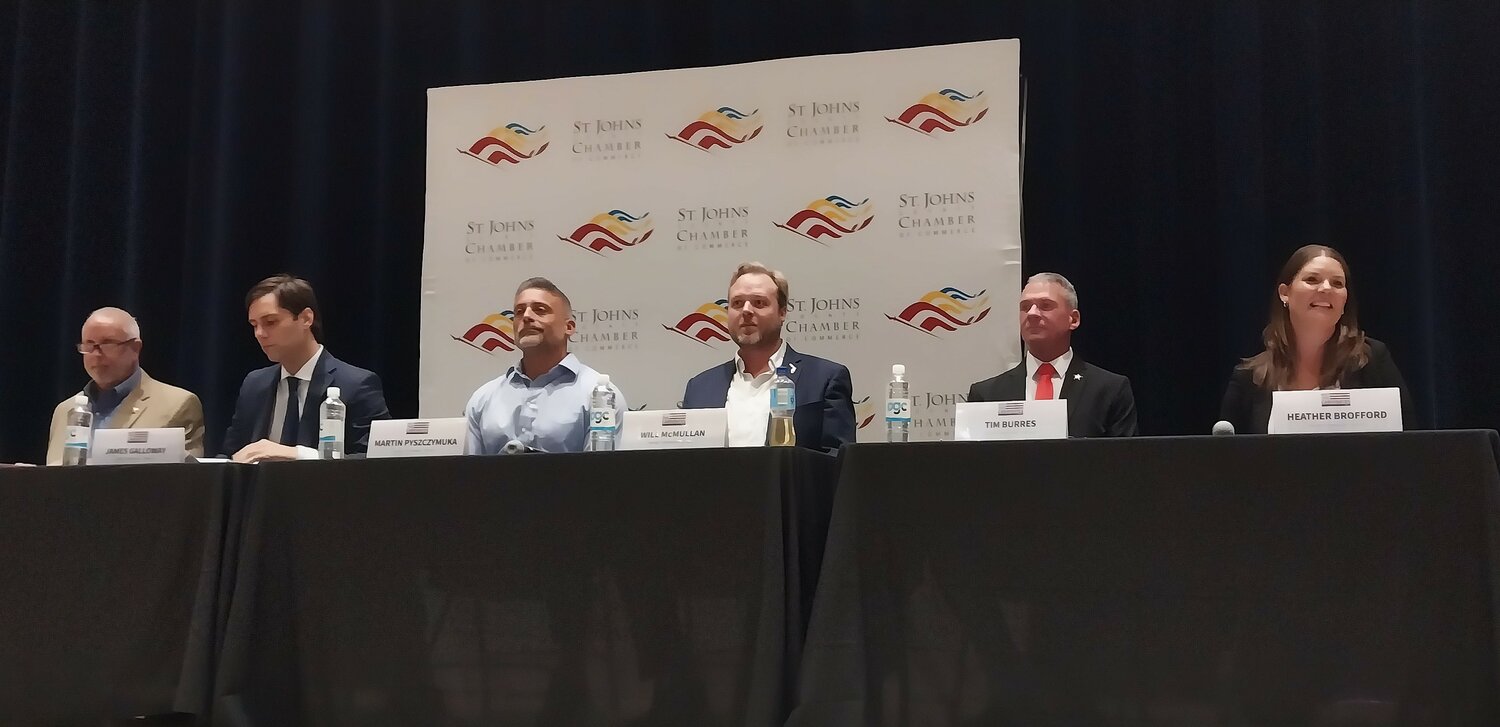


On Thursday, June 25, local residents had their first opportunity to hear county commission candidates address the issues in a forum presented by the St. Johns County Chamber of Commerce. The event, held at Bartram Trail High School, was the first of two planned for this election season.
Making the case for voter support were four District 2 candidates and two District 4 candidates. Seeking the District 2 seat were Heather Brofford, Tim Burres, Will McMullan and Martin Pyszczymuka. Seeking the District 4 seat were James Austin Galloway and Sam Williams.
Krista Keating Joseph, the lone incumbent, was unable to participate as she was attending the Florida Association of Counties annual meeting. Her answers were prerecorded, to be made available online by the Chamber. She is running for the District 4 seat.
All candidates being Republicans, the contest could be determined in the Aug. 18 primary.
During an introduction, the six candidates in attendance gave a little bit of information about their backgrounds and qualifications, as well as the reasons they decided to seek office.
“We want people to stay here; we want people to live, play and have quality of life,” said Brofford, who has served as chair of the Six Mile Creek Community Development District. A vice president and global client executive at Citibank, she has been a resident of St. Johns County since 2011.
“I’ve been here my whole life,” said Burres, a Desert Storm veteran and a former law enforcement officer, now retired from the St. Johns County Sheriff’s Office. “I’ve always been a public servant, and I believe I still have more to offer to the county.”
“I’m running because I want to preserve, protect and restore what makes St. Johns County the most beautiful, most incredible place in the entire world,” said McMullan. “At the same time, I want to build a foundation, so that our children, and their children and their grandchildren can enjoy the quality of life that makes this a place that so many people want to move to.”
McMullan has worked on Wall Street and in multiple industries. He currently works in the consumer packaged goods industry.
“I am here to slow the growth in the county; stop the waste in the county,” said Pyszczymuka, who formerly served in the Federal Air Marshal Service and is retired from the FBI, where he investigated white-collar crime.
“I’m a fifth generation Floridian,” said Galloway, an attorney and business owner, “and I’d like to preserve our beautiful area that we call St. Johns County.”
Williams, who grew up in Ponte Vedra Beach and Jacksonville Beach, worked for the Sheriff’s Office for about 30 years and served as a volunteer firefighter here for almost 10 years.
“After 30 years in law enforcement, I decided to retire,” he said, “but I still have some gas in the tank. I’m still looking to do some good. I still have a servant’s heart.”
When asked about the issues currently facing county residents, the candidates largely agreed that rapid growth and inadequate infrastructure have been problems.
Brofford expressed the frustration many voters are feeling.
“I am tired of paying high taxes,” she said. “I am tired of getting stuck in traffic. And I am tired of communities not being uplifted for the quality of life that we need.”
“We’ve got to make sure that our infrastructure keeps up with our growth,” said Burres. “There’s no doubt that our traffic is out of control. Our infrastructure is not where it needs to be.”
Williams said communities are being built before roads are being adequately addressed.
“It’s like building the second story on your house before you’ve poured your foundation,” he said. “It’s backwards.”
“The focus should be growth management in such a way that it does not upend our infrastructure and our quality of life,” said Galloway.
More than one candidate said developers needed to be held accountable to a greater extent.
McMullan put the blame for many of the problems residents are currently seeing not just on the current commission, but on those in the past.
“I think that our commission has been asleep at the wheel for far too long,” he said. “The reason we’re even in this situation is because we had not fixed this problem 20 years ago. If people complain about the developments that you see today, they don’t know that they were approved back in the early 2000s.”
He tied the problem to a tax base that is concentrated in one place: housing.
“We are getting far too much of our tax revenue from housing and housing development,” he said, adding that only 13% of the county’s tax revenue comes from industry, business, agriculture or other nonresidential sources. He said the state average was 35%. “You wonder why developers have so much power in St. Johns County. It’s because we rely on them for tax revenue.”
“What’s very important is to be able to diversify our tax base,” said Galloway. “Otherwise, the risk is that the homeowners are going to carry that burden.”
Affordable housing continues to be an issue.
“A lot of these public servants don’t make enough to afford the median cost of a house in St. Johns County,” said Williams. “So, we’ve got to figure out that problem.”
Burres emphasized the plight of law enforcement officers.
“They’re living in Putnam County; they’re living in Flagler County; they’re living in Jacksonville,” he said, “and there are current county commissioners that think, well, living in this county’s not a right. If you can’t afford something, go to Jacksonville or Green Cove Springs where it’s cheaper.”
“Over 40,000 people a day commute into the county because they can’t afford to live here,” said McMullan. He pointed out that this contributes to the traffic issues motorists have experienced.
But Pyszczymuka has a different take on the issue. He indicated that arguments for affordable housing always point to the difficulty of first responders and teachers to buy a home.
“The affordable housing argument is in general a Trojan horse for developers to just develop more,” he said. “Affordable housing reverts back to market rate housing in most cases. Now, I’d be all for entertaining possible affordable housing, if it, in fact, stayed affordable. But what we’re talking about is just increasing density in our neighborhoods. Putting more and more people on the roads.”
He challenged the idea that government is the answer.
“The answer is not subsidizing everything,” he said. “The answer is not handouts. The answer is personal responsibility and doing what you need to do if you want a job somewhere. No one’s entitled to live where they want to live. I’m sorry folks. This is the United States of America. I can’t go live on Ponte Vedra Boulevard. I’m not expecting them to subsidize me.”
According to the Northeast Florida Association of Realtors, the median price of a house in St. Johns County in May was $580,000, though the average price is a bit less, generally in the $490s. There are a limited number of homes listed at less than $100,000, though these tend to be small, manufactured homes and double-wide mobile homes.
Galloway expressed the advantage of having affordable housing for workers in the county.
“People who work in St. Johns County should have a realistic housing option in St. Johns County,” he said. “And this is important in the big picture — that they’re keeping local money here.”
In other words, those who live here spend their pay at local businesses.
Several candidates mentioned the importance of attracting high-paying jobs to the county, but not all industry would contribute in a meaningful way to employment.
“We can’t just be a free-for-all for all types of manufacturing,” said Brofford. “We need to be focused. It needs to be dialed in to what the community actually does and needs. It’s business finance, office jobs, it’s health care, medical devices — and a huge one in District 2, food and agriculture.”
“As far as the manufacturing and everything like that, we need to look to bring jobs that aren’t going to be phased out with A.I. or robotics,” said Pyszczymuka. “You know, we bring a huge manufacturer here and no one’s working there. You have robots putting stuff together, and it isn’t really helping the population.”
Along those lines, Pyszczymuka was the only candidate to address A.I. data centers during the event.
“If anybody wants a data center, don’t vote for me, because that’s not what you’re going to get,” he said.
Data centers have drawn a lot of criticism in recent months. Residents living near them say they are a source of noise and light pollution, use a tremendous amount of water and strain power grids, and that there is a lack of transparency. States are beginning to more vigorously regulate, restrict or outlaw data centers.
Candidate opinions varied concerning a measure scheduled to appear on the November general election ballot.
Florida Amendment 3, if passed by 60% of voters, would increase the homestead tax exemption for non-school taxes to $150,000 in 2027 and $250,000 in 2028, with the amount indexed to inflation starting in 2029.
Williams indicated that, had the county relied more heavily on non-residential taxes over the years, the loss of ad valorum tax money would not have been so bad.
“If revenue is decreased, then we’re going to have to focus on efficiency and long-term financial stability,” said Galloway. “This is, of course, done through careful review and seeing where our impacts are, diversifying our tax base and careful stewardship of taxpayer money.”
Pyszczymuka said, “I don’t think it’s going to be as catastrophic as everybody thinks.”
But McMullan took the opposite position.
“Our county has an operating budget of only a little under $400 million a year,” he said. “And some liberal estimates say this could potentially reduce that by half — $200 million a year. Poof! Gone.”
Another concern the candidates addressed was waste, with both Williams and Burres describing their experiences with identifying wasted money during their careers.
Pyszczymuka said he would DOGE (the initials for Department of Government Efficiency that have come to be used as a verb for identifying waste) the county government.
“We are going to figure out exactly where every dime is going,” he said, “starting with our bloated bureaucracy going all the way down to how every individual contract is issued, and looking for any conflicts of interest.”
A second candidates event will be held at 5:30 p.m. Thursday, July 30, at Fullerwood Training Center, 10 Hildreth Drive, St. Augustine. That event will feature candidates running for the St. Augustine City Commission and the mayor of the City of St. Augustine.
For information, go to business.sjcchamber.com/sjc-events-calendar and click on the event.


