
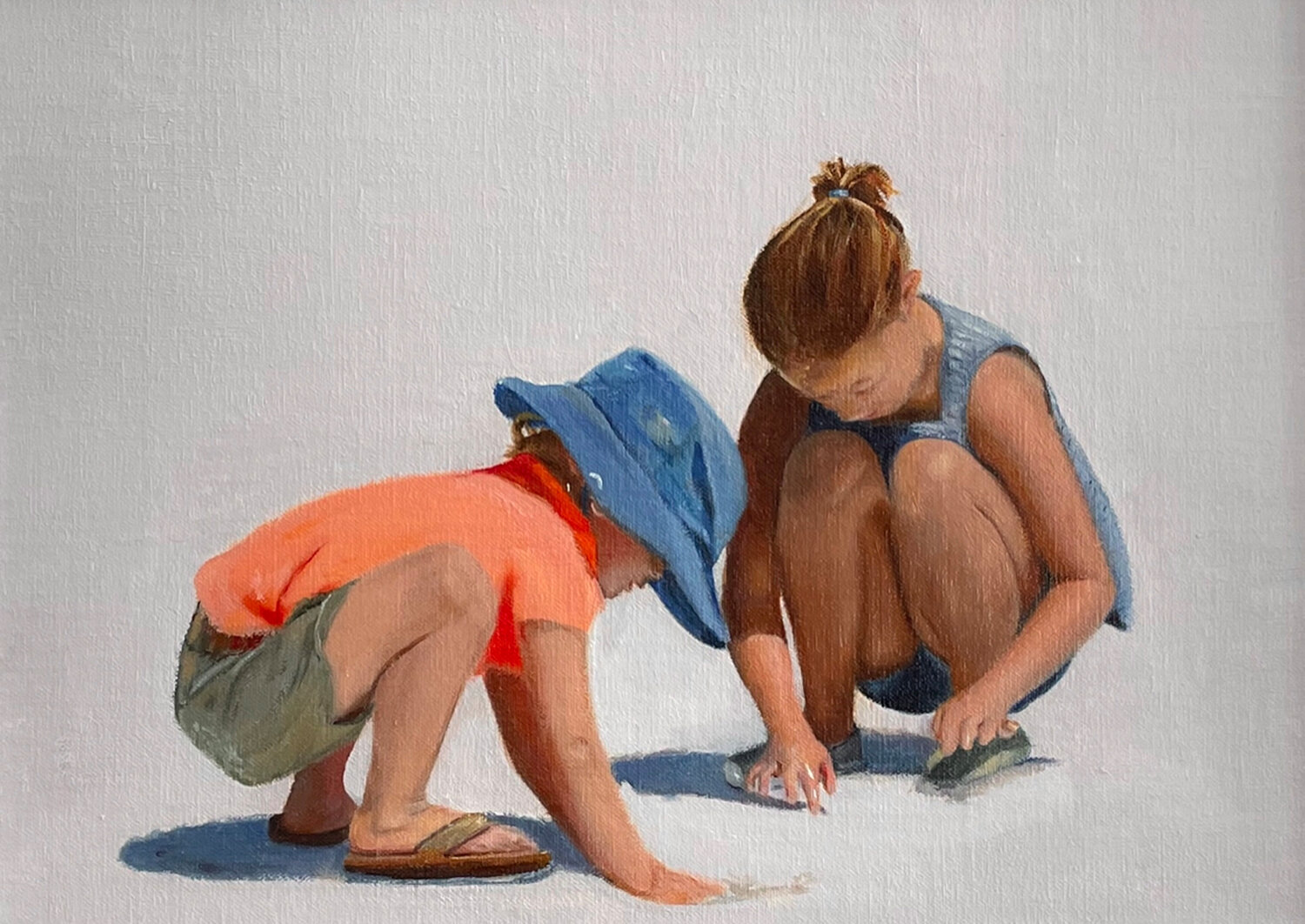



"There are three classes of people: those who see, those who see when they are shown and those who cannot see.” — Leonardo da Vinci
Some artists recall from their earliest memories a passion to create. Others, however, encounter it — often with great surprise — somewhere on life’s journey.
Suzanne Batchelor first experienced the power of her own creativity when she was 15 years old.
Assigned to sketch something in pen and ink for an art class, the New Orleans native ventured down to the bayou and began to draw, not from the surrounding scenery but rather from her imagination.
“It was a girl standing at a fence in a little dress, looking at nature, with birds around,” said Batchelor. “It was like she was daydreaming.”
She became lost in the moment.
“I probably spent two hours out there drawing this, and I was so taken aback by the fact that I was able to create something so quickly,” she said. “I had never done it before. I was like, ‘Where did this come from?’”
Over the years, she honed her art, often asking herself questions regarding the endless decisions she must make while creating a piece. But in the past five years, she has seen a resurgence of this intuitive state, where there seems to be no effort at all, where each brush mark appears to be preordained.
Thus, the cat.
The creative sense
Some time ago, Batchelor had done the underpainting for a picture depicting a black-and-white cat, but then put it away. Two years later, she returned to it.
“I turned on some music, and I just started painting,” she said. “All of a sudden, it’s done — like, in an hour. And it looked like it had come alive. Like, a real cat.”
She had to leave her studio and go out onto her front porch where she described the experience to her husband.
“I don’t know what it was,” she said. “That was the same kind of feeling I had when I was 15 years old.”
In addition to this powerful flow of inspiration, Batchelor has felt driven by a desire to share what she “sees” in that moment where the artist meets her subject.
Thus, the duck.
A moment shared
On early evenings, during what artists call the “golden hour” -- the last, colorful 60 minutes before sunset – birds tend to congregate at a pond in Batchelor’s Amelia Island neighborhood, so she likes to walk there.
One evening, she found a duck standing near the water and experienced a peculiar sense of relationship to it, a moment of empathic, artist-subject understanding.
“It was just so weird,” she said, laughing.
She photographed the duck with plans to paint it later; the result pleased her.
“There were a lot of reflections on the water,” she said. “All these lavenders and grays and salmon pinks and different things that just made it an outstanding painting.”
Batchelor’s approach to her subjects, this celebration and sharing of the present moment -- or, as author Eckhart Tolle might call it, “the now” – was formed in part as a reaction to a friend’s comment.
Once, while traveling in France, Batchelor asked the friend, from whom she has taken a painting class, “If there is one thing that you could teach me about art, what would it be?”
Her friend answered, “The concept.”
It took Batchelor 15 years to figure out what that meant, finally arriving at her current understanding.
“As I look for subjects to paint, I observe the presence of what is around me,” she said.
Creating a bond
Batchelor’s work owes a great deal to her living in Holland as a youth.
Her family lived in Delft, which left her with a lifelong appreciation of the Delft Blue earthenware for which the city is known. Today, vases bearing the famous blue-and-white glaze continue to appear in many of her still lifes, and it’s these pieces that sell very quickly.
Holland was also a great place to learn about the Dutch Masters, and traveling in Europe with her father, visiting cafes and centuries-old farmhouses on photographic explorations, taught Batchelor about the effects of different kinds of light.
“There’s a particular light that you see in Europe at certain times of the year; it’s really hard to reproduce,” she said, speaking in reference to the still life paintings she creates today. “What I try to do is take that memory and then recreate it in some kind of beautiful new moment with things that I find.”
One of those finds was a ewer bearing a Delft Blue glaze and decorative brass spout. Her painting of that piece set next to some apricots she’d purchased at a grocery won her several awards.
The setup for this painting took her an entire day to arrange, but she knew when it was just right – it simply “clicked.”
“There’s this intuition, this energy that comes from within me that clicks with the memory that I have of Holland or wherever I saw the original thing,” she said. “I go, ‘That’s it! That’s what I want to share!’”
Batchelor works exclusively in oils. Her surface of choice is linen, and lately linen over aluminum panels. She’d tried cotton duck on gallery-wrapped canvas but found its uneven surface difficult to work with.
Today, she maintains a studio and gallery in her Amelia Island home, which people can visit by scheduling an appointment. She occasionally does commissions, but she’s very selective; painting to sell is not her primary motivation.
It’s really about works that “resonate” and connecting with other people.
“It’s like something from my heart and soul to your heart and soul,” she said. “I can tell when somebody comes in and looks at my wall of art and when it resonates with them and it touches their soul. I can tell right off the bat. That’s why I paint.”
Learn more about Suzanne Batchelor’s art at suzannebatchelor.com.


